Designing protection for evolving DC architectures
The rapid growth of AI-driven data centers is forcing the industry to rethink not only power distribution architectures, but also the protection technologies that make those architectures possible. Discussions around 800 VDC and even 1500 VDC distribution systems are becoming increasingly common, driven by the need to reduce conversion stages, improve efficiency, and better align with power-electronic loads.
At the same time, the industry is still in the process of defining what these future architectures will look like. This creates a unique challenge for manufacturers of solid-state DC breakers. While the demand for fast DC protection is becoming increasingly clear, the optimal breaker design is not.
The Open Compute Project (OCP) and various industry initiatives are actively exploring LVDC architectures for data centers. These studies provide valuable direction and indicate where the market may be heading. However, they should not be mistaken for finalized standards. Multiple architectures are still being evaluated, and several technical questions remain open.
As a result, manufacturers are faced with an unusual engineering challenge: designing protection systems for architectures that are still evolving.

From AC protection to DC protection
In traditional AC data centers, protection is largely built around technologies that have evolved over many decades. Circuit breakers, fuses, relays, and coordination studies are all based on fault behavior that benefits from a natural current zero crossing.
The challenges of DC fault currents
Fault currents can rise extremely quickly, system impedance is often lower, and there is no natural current zero crossing to assist interruption. In addition, future AI data centers are expected to include significant amounts of distributed energy storage, power electronic converters, and dynamic loads. These elements can contribute fault current from multiple directions.
As a result, protection is no longer a secondary design consideration. It becomes one of the primary factors that determine what architecture is possible.
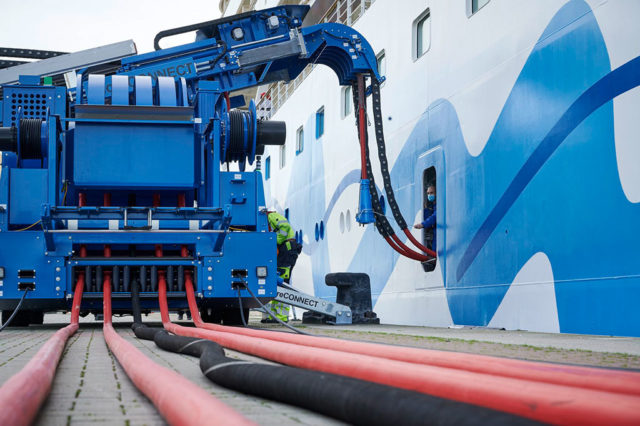
This is a concept that is already familiar in maritime DC microgrids. Modern marine power systems increasingly rely on zonal architectures, integrated energy storage, and fast protection strategies. The same principles are now appearing in discussions surrounding future data center architectures.For facilities where reliability and safety are critical, these risks are simply too high.
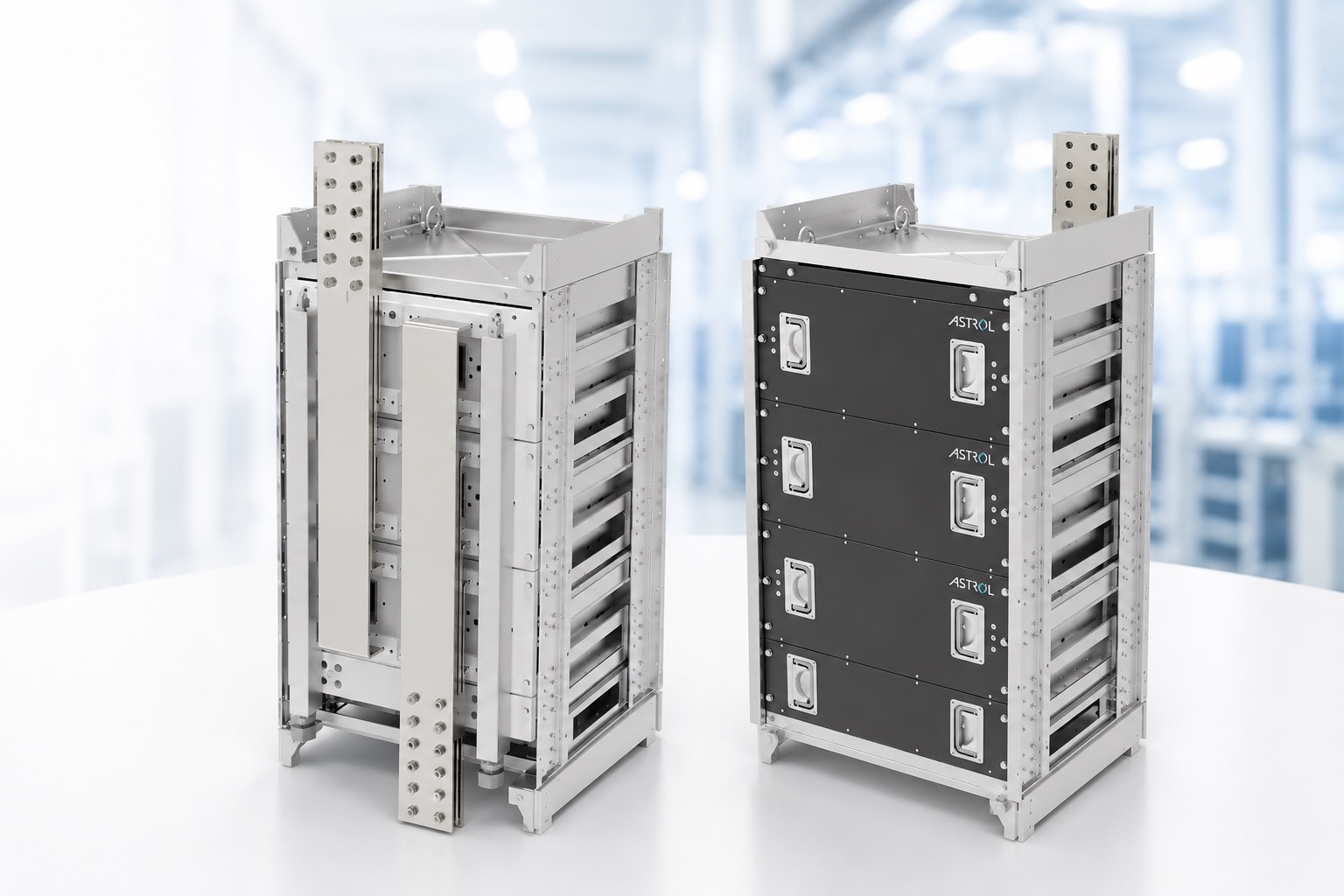
Explore our range of solid-state DC breakers for data centers
Protection defines architecture
One of the most important observations from current industry developments is that advanced DC architectures can only be implemented if suitable protection exists.
A simple radial DC distribution system places relatively modest demands on protection. As architectures evolve toward interconnected zones, distributed storage systems, and potentially meshed DC networks, protection requirements become significantly more demanding.
Future data centers are likely to require multiple layers of protection:
- Main bus protection for high-energy nodes
- Zone and sub-zone protection for fault containment
- Feeder protection for selectivity
- Dedicated protection for batteries and supercapacitor systems
The challenge is not simply interrupting a fault. The challenge is interrupting the correct fault while maintaining service continuity throughout the remainder of the system.
This is where solid-state protection becomes particularly attractive. Microsecond-level response times allow fault energy to be limited before it propagates through the system. However, the implementation details remain open for discussion.
The question of voltage level
One of the most interesting discussions currently taking place concerns the voltage architecture itself.
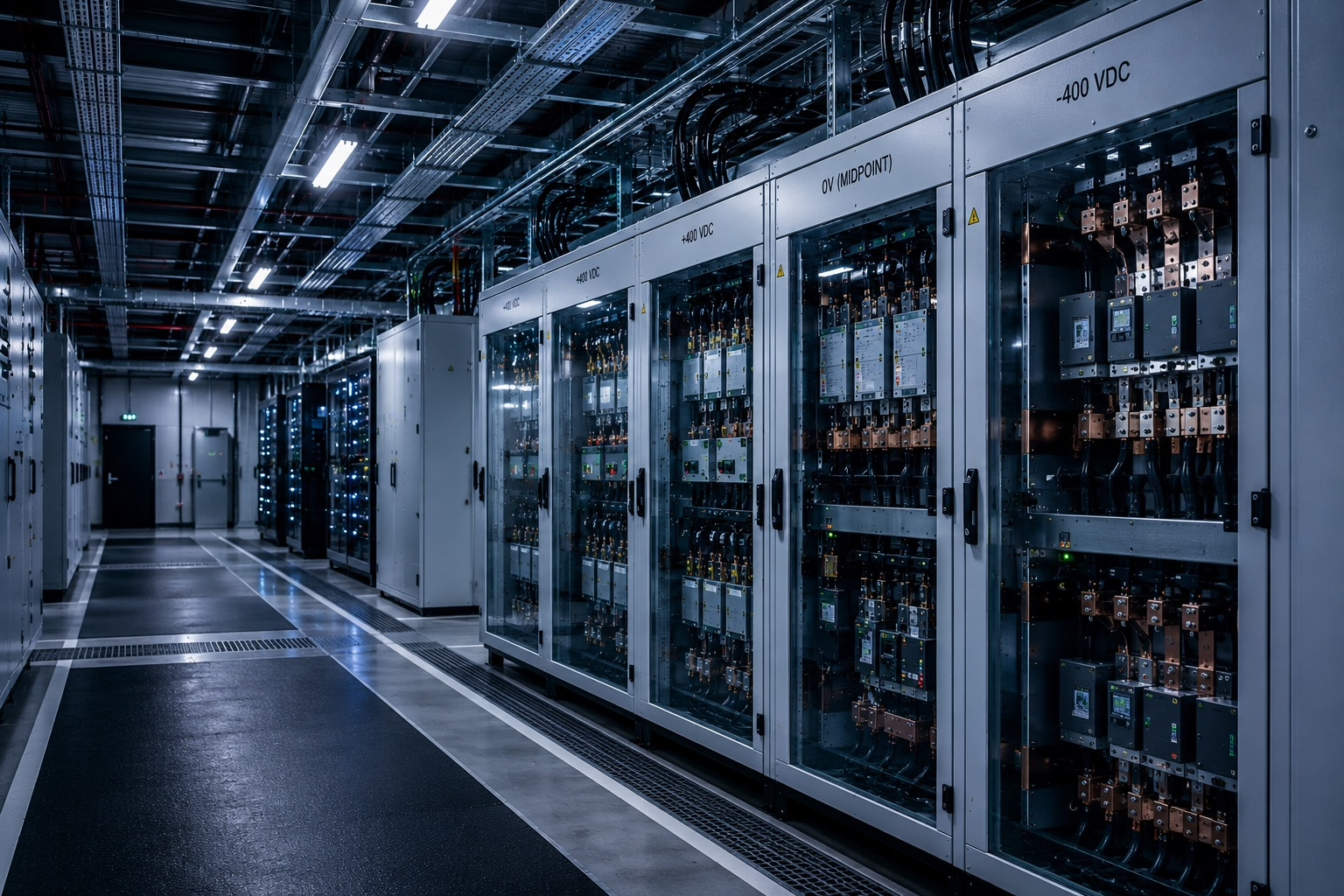
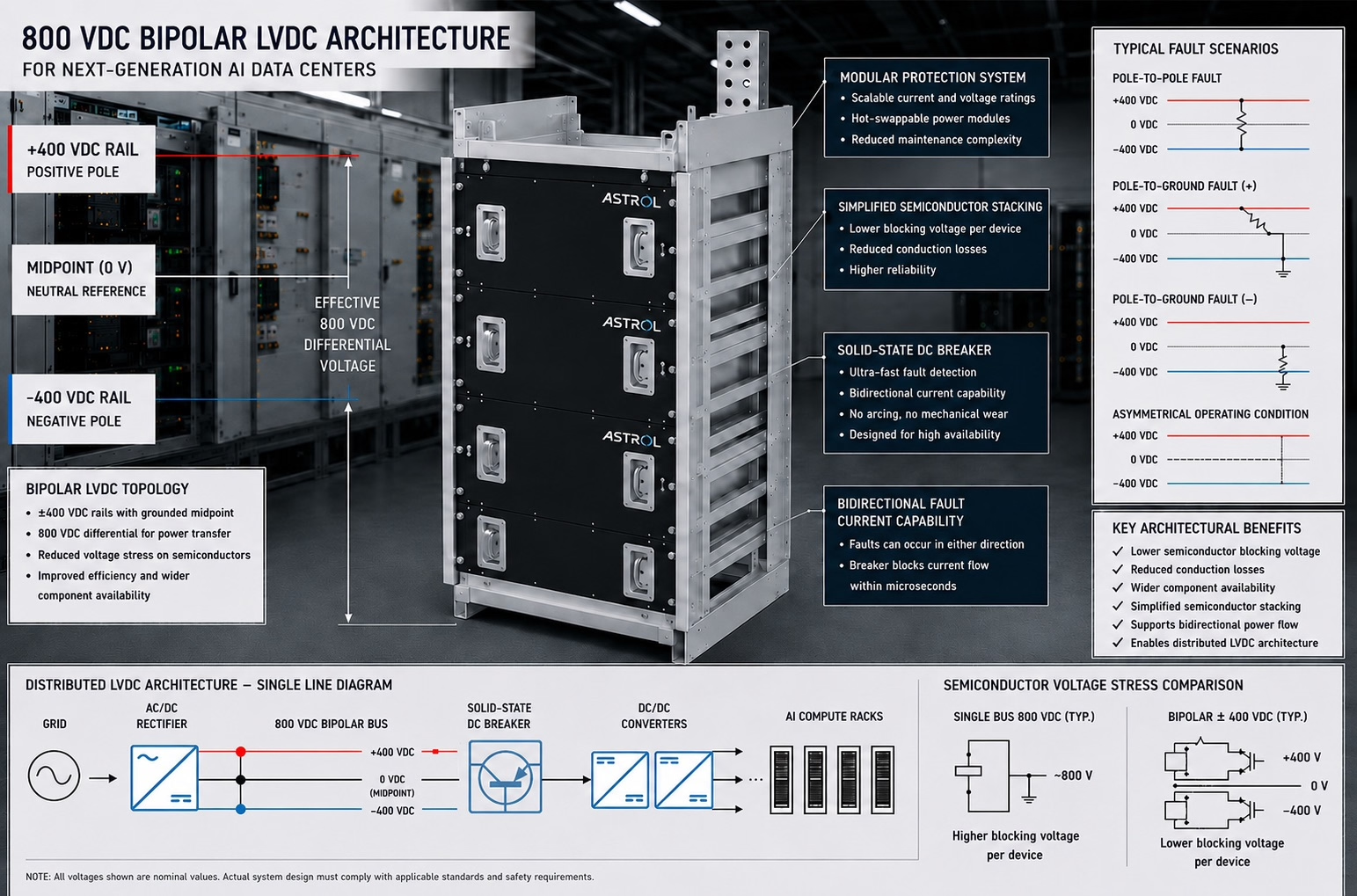
Many future LVDC concepts are based around 800 VDC distribution. Some proposals investigate bipolar topologies such as ±400 VDC, creating an effective 800 V differential voltage while reducing the voltage stress seen by individual semiconductor devices.
From a breaker design perspective, this approach is attractive. Lower semiconductor voltage ratings generally provide:
- Lower conduction losses
- Wider component availability
- Potential cost advantages
- Simplified semiconductor stacking
At first glance, this appears to be an obvious direction. However, the situation is more complex.
A bipolar architecture introduces new protection scenarios, additional operating modes, and fault cases that do not exist in a traditional single-bus system. Pole-to-pole faults, pole-to-ground faults, midpoint stability, and asymmetrical operating conditions all require consideration.
The architecture may simplify semiconductor selection while simultaneously increasing system-level protection complexity.
This creates an important engineering question: Should breaker designs be optimized for a future architecture that may emerge, or should they be designed to support the widest possible range of future systems?At present, there is no definitive answer.
The role of bidirectional power flow
A similar discussion exists around bidirectional operation. Future data centers are expected to include batteries, supercapacitors, renewable energy sources, and highly distributed power conversion. This naturally introduces bidirectional power flow under many operating conditions.
However, bidirectional power flow should not be confused with a fully bidirectional bus architecture. From a protection perspective, reverse current contribution is increasingly likely. Energy storage systems can contribute to faults from multiple directions. Adjacent zones can contribute fault current through interconnected buses.
This means that future breakers must increasingly be evaluated not only on their interruption capability, but also on their ability to manage multi-source fault scenarios.
The maritime industry has already encountered similar challenges. While fully bidirectional architectures remain relatively uncommon, fault contributions from multiple sources are now a standard design consideration.
The same evolution appears likely in data centers.
Fuses, time constants, and the limits of traditional protection
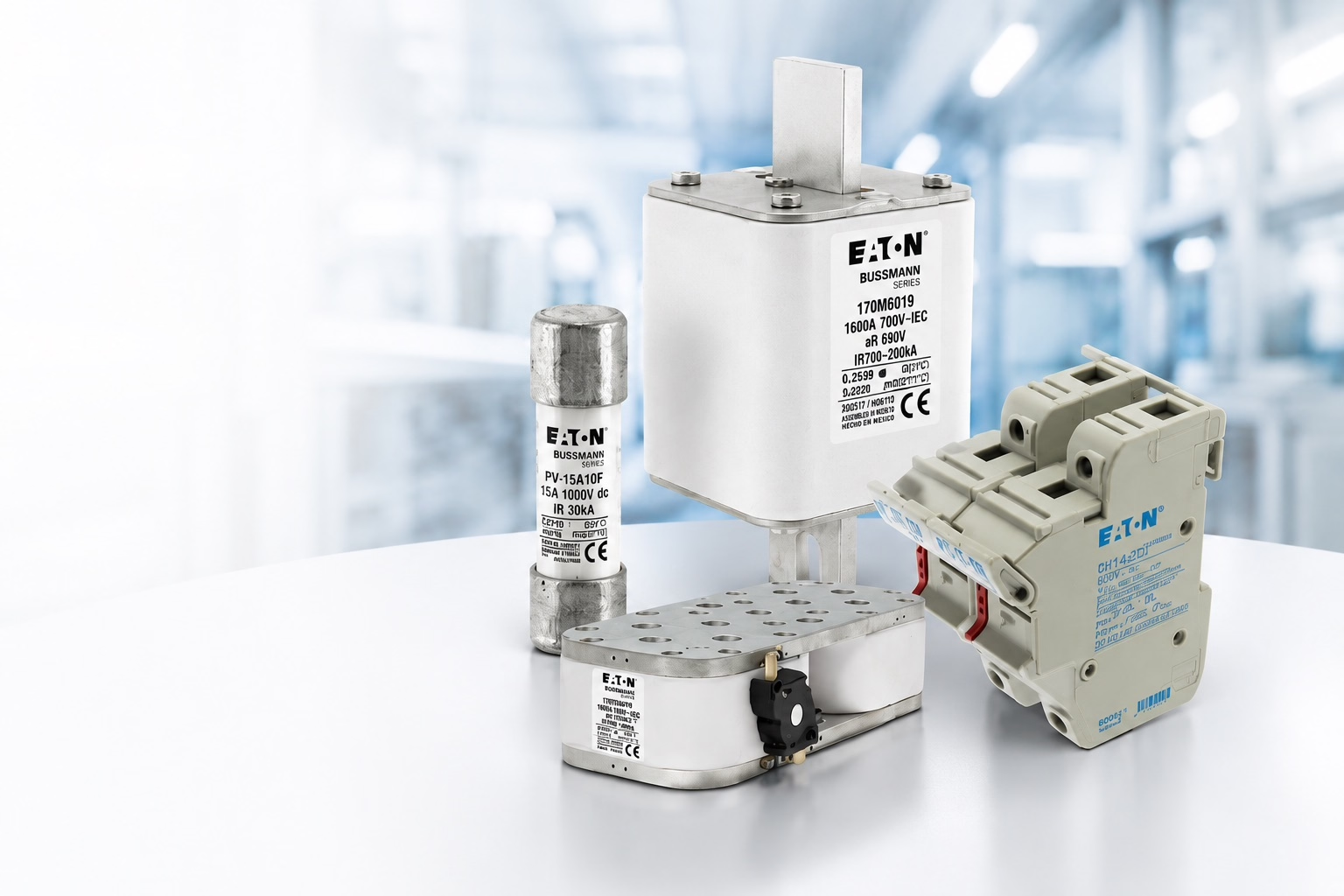
Another important discussion concerns the role of high-speed fuses. Semiconductor fuses such as aR and aBat types remain valuable components and continue to provide effective protection for many applications. However, these technologies were largely developed around fault dynamics that differ from those expected in future AI data centers.
Many fuse designs are based on time constants in the order of milliseconds. Modern LVDC architectures can experience fault development and transient behavior at much shorter timescales. This does not mean fuses are obsolete. Rather, it suggests that fuses may increasingly become part of a layered protection strategy instead of serving as the primary protection mechanism.
In many future architectures, active protection systems and solid-state breakers are likely to work alongside traditional fuse technologies rather than replacing them entirely.
Explore our range of Eaton high speed fuses and specific DC fuses
Certification: the next major challenge
Technical performance alone will not determine success. As discussions with customers increasingly reveal, certification and compliance are becoming equally important. The term “UL approved” is often used in conversations, but in practice this can mean very different things. Some customers accept products that are designed in accordance with UL requirements. Others require a fully listed and certified product.
For solid-state breakers, the situation is particularly interesting. Historically, certification frameworks focused on mechanical interruption technologies. Newer standards such as UL 489I recognize that solid-state circuit breakers behave differently and require additional evaluation.
Perhaps the most significant implication is the growing emphasis on galvanic isolation. A semiconductor can interrupt current, but it does not provide the same physical isolation as an open contact system. Consequently, modern certification approaches increasingly view solid-state breakers as complete protection systems rather than simply semiconductor switching devices.
This raises an important question for manufacturers. Should the isolation function be part of the breaker itself, or should it be provided elsewhere in the system?
From a certification perspective, integrating the isolation function into the certified product boundary appears increasingly attractive. It simplifies responsibility, improves clarity for customers, and aligns more closely with emerging certification approaches.
However, it also increases complexity and development effort.
Designing for an uncertain future
Perhaps the most challenging aspect of solid-state DC breaker development today is that there is no single architecture to design for.
- The industry is moving toward LVDC (low voltage DC)
- The importance of fast protection is becoming clear.
- Energy storage integration is increasing.
- Protection requirements are becoming more demanding.
- Yet many of the details remain undecided.
- For manufacturers, this means flexibility may be more valuable than optimization.
A breaker designed around a very specific future assumption may prove highly efficient but poorly positioned if the market evolves differently. Conversely, a more topology-agnostic design may initially appear less optimized but ultimately support a wider range of architectures.
This is particularly true for data centers, where deployment cycles are measured in years while architectural evolution continues at a much faster pace.
Astrolkwx is specialist in solid-state breaker and switching technologies and we offer a complete range of Astrol solid-state DC breakers in the range of 0.35 kA – 7.5 kA with nominal voltages of 800 and 1500 V, higher upon request.
Conclusion
The transition toward AI-driven infrastructure is creating unprecedented opportunities for solid-state protection technologies. At the same time, it is forcing manufacturers to make design decisions before the industry has fully converged on a preferred architecture.
Questions surrounding voltage levels, bipolar distribution, bidirectional operation, energy storage integration, certification, and galvanic isolation are still being actively debated. The challenge is therefore no longer proving that solid-state breakers can work. The challenge is determining what the optimal solid-state breaker should be for a future that is still being defined.
For engineers developing next-generation protection systems, that uncertainty may be the greatest design challenge of all.

Frequently Asked Questions (FAQ)
Semiconductor fuses remain an important protection technology, but they operate by melting a fuse element, making their response dependent on fault current magnitude and the fuse’s I²t characteristic. In modern LVDC systems with high-power converters and distributed energy storage, fault currents can develop within tens of microseconds. A solid-state breaker can actively interrupt the fault before excessive energy propagates through the system. In future AI data centers, fuses are therefore expected to complement rather than replace active protection devices as part of a layered protection strategy.
The voltage architecture affects far more than insulation levels. A single-bus 800 VDC system presents different fault scenarios than a bipolar ±400 VDC architecture. Bipolar systems introduce additional considerations such as pole-to-pole faults, pole-to-ground faults, midpoint voltage stability, and asymmetric loading. While bipolar distribution may reduce semiconductor voltage stress, it also increases system-level protection complexity.
In AC systems, current naturally passes through zero twice per cycle, which helps extinguish electrical arcs. DC current has no natural zero crossing, allowing an arc to sustain itself unless interrupted actively. A DC breaker must therefore force current interruption while safely managing the energy stored in cables, inductances, and DC-link capacitors. This fundamentally changes breaker design compared to conventional AC protection.
Unlike conventional generators or transformers, power electronic converters do not always behave as ideal voltage sources during faults. Depending on their control algorithms and hardware design, converters may actively limit fault current, temporarily increase it, or disconnect rapidly. Since different converter technologies respond differently, fault current analysis in LVDC systems becomes significantly more complex than in traditional electrical distribution networks.
In a conventional radial system, fault current generally originates from a single upstream source. Future AI data centers will increasingly include batteries, supercapacitors, multiple converters, and distributed power supplies, all of which may contribute fault current simultaneously. Protection devices must therefore identify not only the existence of a fault, but also its location, direction, and the appropriate device to operate first in order to maintain service continuity elsewhere in the network.
Not necessarily. Bidirectional power flow simply means that energy may flow in either direction during normal operation. Protection requirements are different. A breaker must be capable of detecting and interrupting fault currents regardless of their direction of origin. Whether this requires a fully bidirectional switching topology depends on the network architecture and the expected fault current paths.
Lower system impedance allows fault current to rise much faster, resulting in higher di/dt and significantly shorter reaction times for protection devices. As power densities increase, cable lengths decrease, and energy storage is installed closer to critical loads, overall network impedance is expected to decrease. This places increasingly demanding performance requirements on fast protection technologies.
Electronic interruption stops current flow but does not create a visible physical isolation gap like an open mechanical contact. For maintenance, personnel safety, and regulatory compliance, many applications require verified galvanic isolation. As a result, future protection systems may combine solid-state interruption with an integrated or separate mechanical isolation function.
Battery systems and supercapacitors can deliver extremely high fault currents for short durations. Instead of one dominant fault source, protection systems must manage simultaneous contributions from multiple storage systems and converters. Coordination therefore becomes more dynamic, requiring protection strategies that account for source interaction, converter behavior, and energy storage characteristics.
Not every DC installation requires microsecond response times. The required interruption speed depends on system impedance, available fault energy, converter sensitivity, and the desired level of service continuity. However, in high-power AI data centers, limiting fault energy within microseconds can significantly reduce stress on power electronic equipment and prevent cascading failures.
The industry has not yet converged on a single preferred LVDC architecture. A breaker optimized exclusively for one topology may become less suitable if market preferences evolve differently. A topology-agnostic design offers greater flexibility by supporting multiple voltage levels, grounding concepts, and network configurations, reducing long-term integration risk.
When several intelligent protection devices are installed throughout the network, coordination becomes increasingly important. Without proper selectivity, multiple breakers may trip unnecessarily or fail to isolate the fault optimally. Future LVDC systems may therefore rely on advanced coordination algorithms, communication between protection devices, or hybrid approaches combining local intelligence with centralized supervision.
Existing certification frameworks were originally developed around mechanical interruption technologies. Solid-state breakers introduce additional considerations such as semiconductor reliability, electronic fault detection, thermal management, software functionality, and the absence of inherent galvanic isolation. Consequently, certification increasingly evaluates the complete protection system rather than only its switching capability.
Not in every application. Solid-state breakers provide extremely fast interruption and excellent fault energy limitation, while mechanical breakers offer visible isolation and well-established safety functions for maintenance. Many future LVDC systems are therefore expected to combine both technologies, allowing each to perform the function for which it is best suited.
The greatest challenge is not demonstrating that solid-state interruption works—it already does. The challenge is designing a protection platform that remains effective across future architectures that have not yet been standardized. Manufacturers must balance optimization for performance against flexibility, ensuring that today’s designs remain compatible with tomorrow’s evolving LVDC infrastructures.